Use the device your staff already carry
Connect a compatible phone or tablet to the labels through the mobile workflow. Staff can manage a price or product-information change at the shelf instead of printing and replacing paper.

Update shelf prices and product information from a compatible phone or tablet. For the basic local workflow, Tocvue BLE ESL does not require an access point—making it a practical starting point for small stores, pilots and local label updates.
The value is not Bluetooth by itself. The value is a lighter operating model for a store that has a limited number of labels, changing promotions and no reason to install a complex system.
Connect a compatible phone or tablet to the labels through the mobile workflow. Staff can manage a price or product-information change at the shelf instead of printing and replacing paper.
No access point is required for the basic local workflow. This reduces the initial project footprint for a single store, a new shop or a controlled pilot.
Paper labels, handwritten changes and mixed promotion styles make a phone shop look unfinished. E-paper templates create a cleaner shelf edge while keeping pricing visible in bright retail lighting.
Use the actual app and label configuration for the final training material. The page describes the verified operating logic, not an unconfirmed promise about simultaneous update capacity.
Create or import the product name, price and other fields needed for the store.
Bind the fields to a label layout for a price, promotion or product-information display.
Use the compatible mobile workflow to identify nearby BLE labels and bind them to products or label codes.
Trigger the queued update, then check the physical label before the promotion or price change goes live.
A good landing page should also tell a buyer when BLE is not the best answer. That transparency improves lead quality and gives the sales team a clear upgrade path.
| Project question | BLE series | SDR / 2.4GHz architecture |
|---|---|---|
| How is the label updated? | Compatible phone or tablet through the BLE mobile workflow. | Access point and centralized platform workflow. |
| Best starting point | Small single-location shop, local updates, sample or pilot project. | Large store, many labels, multiple locations or centrally managed operations. |
| Infrastructure | No access point required for the basic local workflow. | Gateway/network planning is part of the project. |
| When to ask for the other option | When the project needs centralized POS/ERP synchronization, frequent automated updates or multi-store control. | When a store wants centralized operations and a scalable deployment architecture. |
These are the most useful starting points for phone, accessory and compact 3C retail. Other BLE sizes are available; final model, color and resolution are confirmed with the project.
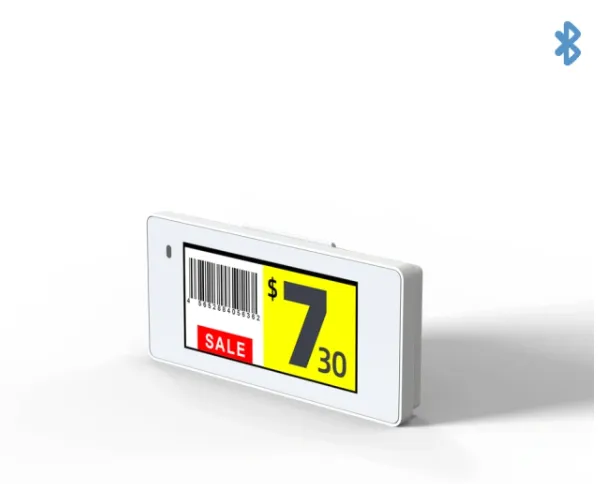
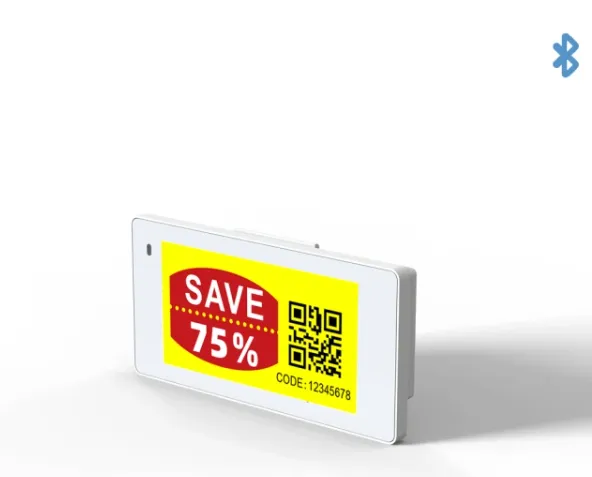
2.66 inch · 296×152 · B/W/R/Y · CR2450×2
More horizontal space for product details.
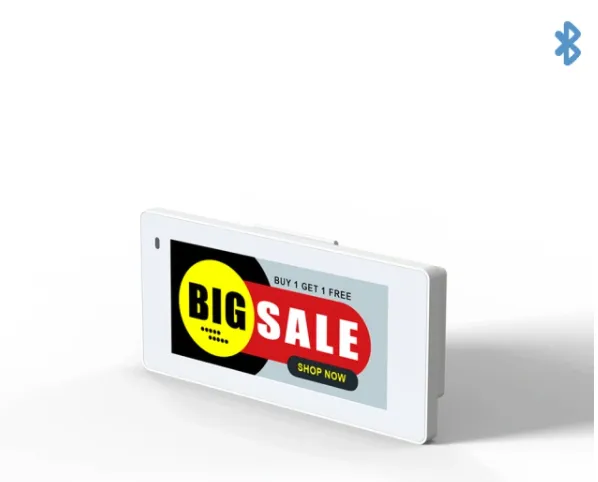
2.90 inch · 296×128 · B/W/R/Y · CR2450×2
Balanced choice for compact retail shelves.
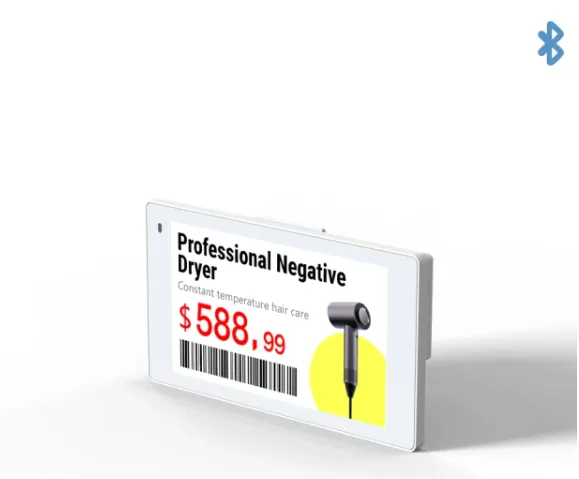
3.70 inch · 416×240 · B/W/R/Y · CR2450×2
More room for phone and electronics details.
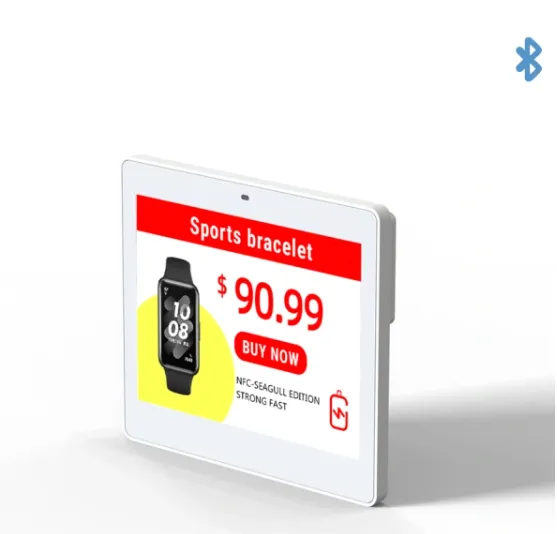
4.20 inch · 400×300 · B/W/R/Y · CR2450×3
Larger promo or display-table content.
A useful inquiry is more than “send price.” It tells us whether BLE is the correct architecture and which label sizes should be sampled.
Phone shop, phone accessories, 3C electronics, repair counter, boutique or another small-format retail environment.
Estimated label quantity, shelf width, product categories, preferred display size and whether a sample is needed first.
Local manual updates, promotion frequency, number of stores, and whether POS/ERP or centralized management is part of the future plan.
It is an electronic paper shelf label that communicates with a compatible phone or tablet over Bluetooth. For the basic local workflow, no access point is required. Store staff can create or import product information, bind a label to a product, and trigger a refresh from the mobile workflow.
BLE ESL is a good starting point for a small single-location phone shop, 3C store, boutique or pilot project where staff update labels locally. Final suitability depends on label quantity, store layout, update frequency and whether centralized POS or ERP synchronization is required.
The basic local phone-to-label workflow does not require an access point. Confirm the exact model, app workflow and project configuration before ordering. Larger or centralized deployments may be better matched to Tocvue's SDR or 2.4GHz architecture.
The 2.13-inch and 2.66-inch formats are useful starting points for compact accessory or shelf labels. The 2.90-inch, 3.70-inch and 4.20-inch formats provide more space for product details, promotions or larger price display. The final choice should follow viewing distance, shelf width, information density and product layout.
Confirm the exact BLE model, display colors and resolution, phone or tablet compatibility, label quantity, store layout, intended update workflow, mounting accessories, battery specification, sample availability and whether a future POS, ERP or multi-store rollout is required.
Send us your store type, estimated label quantity, product categories and preferred phone/tablet workflow. We will help you check the architecture and recommend a sample combination.