
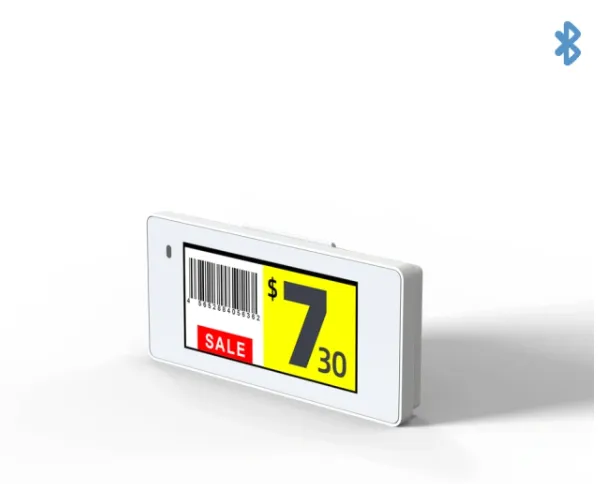
One of the most common questions retailers ask us is: How do I know if I'm ready for ESL?
It's a smart question. ESL is an investment — not just in hardware, but in process change. Deploying it too early means overpaying for capability you don't need. Deploying too late means leaving money on the table.
Here are seven clear signs that your store is ready to make the switch from paper to electronic shelf labels.
Sign 1: You're Changing Prices More Than Once a Week
The single biggest cost ESL eliminates is labor spent on manual price changes. If your team is updating shelf tags daily or even multiple times per week, the labor savings alone can justify ESL.
Evaluate: Track how many person-hours your team spends on price changes per week. Multiply by 52. If that number exceeds $10,000-15,000 annually, ESL is worth a serious look.
What it tells you: High price-change frequency means rapid payback on labor savings.
Example
A 10,000-SKU supermarket changing 1,000 prices per week at 45 seconds each = 12.5 hours/week = $9,000-15,000/year in labor. ESL reduces this to near zero.
Sign 2: You're Managing Multiple Locations
ESL's value compounds with scale. A single store can justify ESL, but the real power emerges at 3+ locations:
- Centralized price updates — change prices across all stores in seconds
- Consistent pricing — eliminate location-to-location discrepancies
- Standardized promotions — launch campaigns simultaneously chain-wide
Evaluate: Count your locations. For 3+ stores, include centralized management capability in your ESL evaluation criteria.
Sign 3: Your Pricing Errors Are Costing You
Shelf-to-scanner mismatches are more expensive than most retailers realize:
- Each mismatch costs $3-5 in staff time to resolve
- Regulatory fines in some markets (e.g., Canada, EU) for pricing violations
- Customer trust damage — 68% of shoppers notice pricing errors
Evaluate: Run a manual audit of 500 shelf prices vs. POS prices. If error rates exceed 2%, ESL is a concrete solution — not just a nice-to-have.
| Error Rate | Severity | ESL ROI Impact |
|---|---|---|
| < 1% | Low | Marginal benefit for error reduction |
| 1-3% | Moderate | Error elimination helps justify investment |
| > 3% | High | Error savings alone can pay for system |
Sign 4: You Run Frequent Promotions or Dynamic Pricing
If your business model depends on frequent pricing changes — weekly promotions, flash sales, seasonal markdowns — ESL transforms what's operationally possible:
- Launch a store-wide sale in under 30 seconds
- Implement time-based pricing (happy hours, early-bird discounts)
- Automate perishable markdowns based on expiry dates
Evaluate: Count your promotional events per month. At 15+ events, ESL's speed advantage becomes a competitive necessity.
Sign 5: You're Expanding or Renovating
If you're already planning a store remodel or new store opening, the incremental cost of installing ESL infrastructure is much lower than a retrofit:
- Construction crews already on site
- Network infrastructure being installed anyway
- Staff already being trained on new systems
Evaluate: Any planned construction in the next 6-12 months creates a natural ESL deployment window. The installation cost premium drops by 40-60% when done during a remodel vs. as a standalone project.
Sign 6: Your Staff Are Overstretched
Retail labor is getting more expensive and harder to find. If your store teams are spending significant time on:
- Printing and cutting paper labels
- Walking the floor to replace tags
- Auditing shelf prices against system prices
- Responding to customer complaints about pricing errors
...then ESL isn't just a cost-saving tool — it's a staff retention tool. Freeing up 10+ hours per week per store lets existing staff focus on high-value activities: customer service, merchandising, and sales.
Evaluate: Survey your store managers: "If you had 10 more hours per week, what would you do differently?" The answers will tell you whether ESL is about cost savings or capability expansion.
Sign 7: Your Competition Already Has ESL
This may be the simplest sign of all.
In Europe, ESL adoption exceeds 80% in many retail categories. In North America, it's approaching 30% and accelerating rapidly — Walmart announced full deployment across all US stores by end of 2026. Once ESL reaches critical mass in your market, paper labels become a competitive disadvantage.
Evaluate: Visit 5 competitor stores in your market. If 2+ are using ESL, you're already behind. If none are, you have a window to be an early adopter and gain a pricing agility advantage.
The ESL Readiness Scorecard
Add up your score:
| Sign | Yes (2 pts) | Partially (1 pt) | No (0 pts) |
|---|---|---|---|
| 1. Changing prices 1+/week | |||
| 2. Multiple locations | |||
| 3. Pricing errors above 2% | |||
| 4. Frequent promotions | |||
| 5. Planned construction | |||
| 6. Staff overstretched | |||
| 7. Competitors using ESL |
12-14 points: Deploy ESL now — you're leaving money on the table
8-11 points: Strong candidate — run a pilot in one department
4-7 points: Prepare — start gathering data for a business case
0-3 points: Not yet — revisit in 6-12 months as the market evolves
Final Word
ESL readiness isn't binary. Most retailers land somewhere on the spectrum. The key is to assess honestly, pilot strategically, and scale based on real data — not vendor promises.
The good news is that ESL technology has matured, prices have dropped significantly, and implementation is simpler than ever. When you see 5+ of these signs in your operation, it's time to make the move.
About the author: This assessment framework was developed based on ESL adoption patterns observed across retail buyers in global markets.
Need a Retail Security Solution?
Get a free consultation and custom recommendation for your store. Factory-direct pricing, global shipping.
Request Free Assessment