
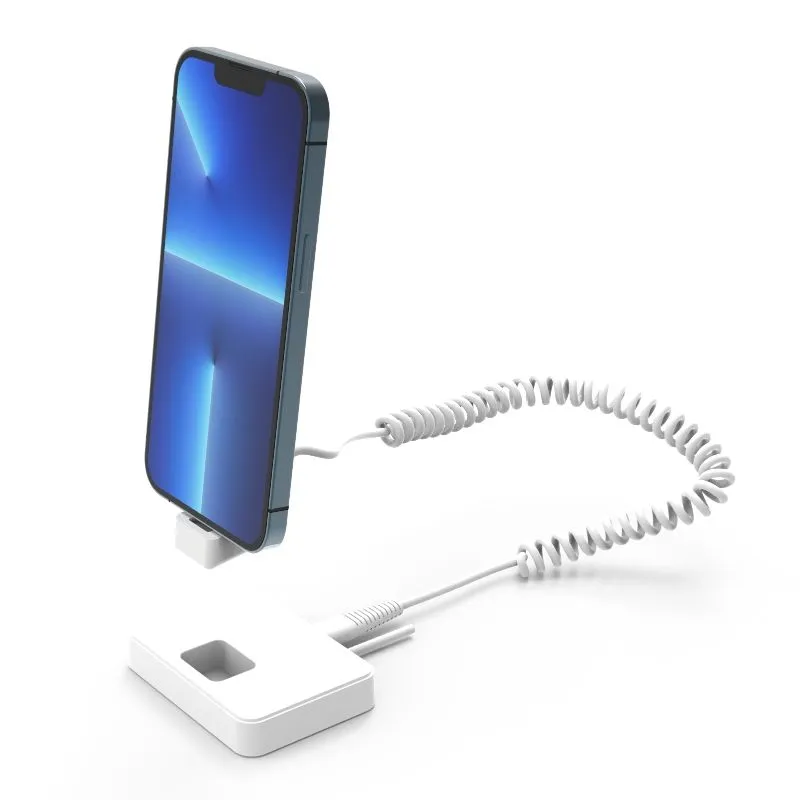
Walk into any major electronics retailer today, and you'll see a familiar sight: rows of smartphones displayed on open counters, inviting customers to pick them up, swipe through screens, and compare models side by side.
This open-plan display approach became the retail standard for good reason — it drives engagement, increases dwell time, and ultimately converts more sales. But it also creates a security challenge that continues to evolve as both theft methods and display technology advance.
The Open-Plan Reality
In 2026, the majority of consumer electronics purchases still happen in physical stores. Despite e-commerce growth, customers want to hold a phone before they buy it — particularly in the premium segment above $500.
This creates an inherent vulnerability. A flagship smartphone on an open display is both a sales tool and a theft target. The challenge is that modern retail design demands:
- Unobstructed product access
- Clean, minimalist aesthetics
- Self-service browsing
- Working demo units with live charging
Traditional solutions like locked glass cabinets work against all four demands.
How Open-Plan Security Has Evolved
First Generation: Passive Deterrence
The earliest approach relied on visible locks and tethers. Mechanical pull boxes and basic cables prevented casual grab-and-run theft but did nothing against determined thieves equipped with wire cutters.
Limitation: No alarm, no alert, no remote management.
Second Generation: Individual Alarm Stands
Standalone alarm stands added a critical layer. When a device was lifted or its cable was cut, a 90dB+ alarm sounded, drawing immediate attention.
Limitation: Each stand operated independently. Store staff had to physically approach and disarm each alarm, creating friction in high-traffic scenarios.
Third Generation: Wireless-Controlled Security Systems
Modern security stands use 2.4GHz wireless remote control, allowing staff to:
- Disarm multiple stands from across the floor
- Switch between silent and audible alarm modes
- Detect low battery conditions before they become issues
- Respond to triggered alarms without walking to each station
This is where the industry sits today — and it strikes the best current balance between security and customer experience.
Fourth Generation: The Emerging Standard
The next wave, already being adopted by forward-thinking retailers, integrates centralized multi-port controllers. A single controller manages multiple display stands, reducing both hardware cost (by up to 40% compared to individual units) and management complexity.
Choosing the Right Security Level by Store Type
Not every store needs the same security posture. Here's a framework:
Flagship Stores / High-Traffic Urban Locations
- **Risk level**: High (more foot traffic, more attempted theft)
- **Recommended**: Wireless alarm stands with retractable steel cables, centralized controller, remote disarm
- **Key metric**: Response time to alarm events matters — centralized control cuts response from minutes to seconds
Suburban / Mid-Traffic Stores
- **Risk level**: Moderate
- **Recommended**: Standard alarm stands with wired cable lock
- **Key metric**: Balance between cost per display point and adequate coverage
Kiosks / Pop-Up Stores
- **Risk level**: Variable (depends on location and duration)
- **Recommended**: Compact alarm stands with reinforced housing, easy setup/teardown
- **Key metric**: Portability and speed of deployment
Specialty / High-Value Retailers
- **Risk level**: High (individual item value often exceeds $1,000)
- **Recommended**: Titan-series high-security stands with 90dB alarm, reinforced housing, heavy-duty retractable cable
Practical Tips for Open-Plan Display Security
- **Create security zones**: Group high-value items in areas with good sightlines and dedicated staff presence
- **Use visual deterrents**: The presence of alarm stands with visible cables and warning indicators reduces opportunistic theft by an estimated 40-60%
- **Implement a disarm protocol**: Ensure staff know exactly how and when to use remote disarm features — an alarm that doesn't get addressed quickly erodes deterrence
- **Maintain cable integrity**: Retractable steel cables should be inspected weekly for wear, particularly at connection points
- **Consider charging integration**: Modern security stands include charging capabilities, eliminating the need for separate charging stations and reducing cable clutter
The Bottom Line
Open-plan display is here to stay. The question isn't whether to secure your devices — it's how to do so without compromising the customer experience. Third-generation wireless security display stands offer the best current solution, with centralized control systems representing the next logical step for chain retailers.
The right security setup pays for itself in reduced shrinkage, improved staff efficiency, and — most importantly — higher conversion from customers who could actually touch and explore the product before buying.
About the author: This article was contributed by a retail security specialist from Shenzhen, China, with experience in the retail security display industry.
Need a Retail Security Solution?
Get a free consultation and custom recommendation for your store. Factory-direct pricing, global shipping.
Request Free Assessment