
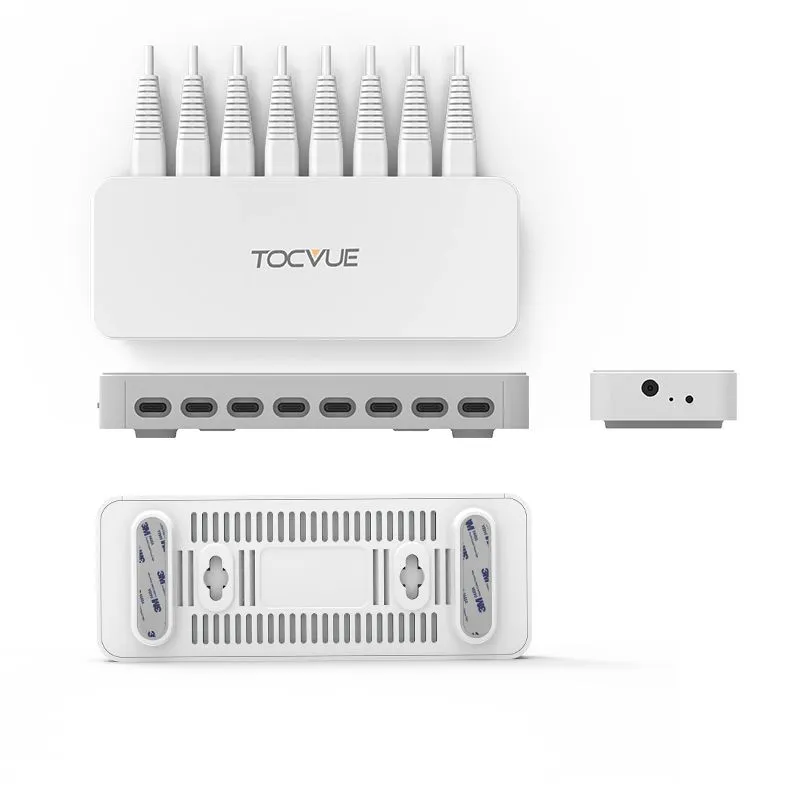
Walk through the electronics section of most large retailers today, and you'll see a common setup: individual alarm stands for each display device, each with its own battery, its own alarm, and its own management.
It works. But there's a more efficient way.
Centralized security controllers — where a single unit manages 4-8 individual display stands — are quietly becoming the preferred solution for chain retailers and high-density display environments. Here's why.
The Traditional Approach: Fully Distributed
In a fully distributed setup, each display stand is a self-contained unit:
```
Stand 1 ──[battery]──[alarm]──[controller]
Stand 2 ──[battery]──[alarm]──[controller]
Stand 3 ──[battery]──[alarm]──[controller]
Stand 4 ──[battery]──[alarm]──[controller]
Stand 5 ──[battery]──[alarm]──[controller]
Stand 6 ──[battery]──[alarm]──[controller]
```
Every stand duplicates the expensive parts: alarm module, battery, wireless receiver. Multiply that by 20, 50, or 200 display points, and the cost adds up fast.
Typical cost: $25-50 per display point
The Centralized Approach: Shared Intelligence
A centralized system separates the "smarts" from the stands:
```
┌─ Stand 1 ──[basic cable]
├─ Stand 2 ──[basic cable]
Controller ────[alarm]──[battery]──[wireless]──┼─ Stand 3 ──[basic cable]
├─ Stand 4 ──[basic cable]
└─ Stand 5 ──[basic cable]
```
The controller handles alarm management, battery backup, and wireless communication for all connected stands. Each individual stand is simpler — just a cable and connector — significantly reducing per-point cost.
Typical cost: $40-60 for the controller + $8-15 per stand = $12-25 per display point
The Financial Case
8-Point Deployment Comparison
| Cost Item | Individual Stands | Centralized Controller |
|---|---|---|
| 8 full alarm stands | 8 × $35 = $280 | — |
| 1 controller | — | $50 |
| 8 basic stands | — | 8 × $12 = $96 |
Multi-Store Scaling
| Store Count | Individual (8 pts/store) | Centralized (8 pts/store) | Total Savings |
|---|---|---|---|
| 1 store | $280 | $146 | $134 |
| 10 stores | $2,800 | $1,460 | $1,340 |
| 50 stores | $14,000 | $7,300 | $6,700 |
| 100 stores | $28,000 | $14,600 | $13,400 |
These savings don't account for reduced battery management and simplified installation — which add further operational savings.
Beyond Cost: Operational Advantages
Simplified Battery Management
With individual stands, you have 8 batteries to track, with different discharge rates and replacement schedules. With a centralized controller, you have one battery (or AC power) to manage.
The controller can be plugged into a standard power outlet with battery backup, eliminating battery replacement for the individual display points entirely.
Operational impact: Maintenance impact depends on the selected system and store setup; compare service requirements before and after deployment.
Easier Installation and Maintenance
Individual alarm stands require more wiring, more mounting, and more individual configuration. Centralized controllers connect to stands via thin cables that are simpler to run and conceal.
When a stand needs replacement, you only swap the simple cable/connector assembly — not a full alarm module.
Impact: Installation time depends on site layout, cabling and selected models., 50% lower replacement cost per failed unit.
Centralized Management
A single remote can manage an entire store's display security. One button disarms all connected stands. One status check shows the battery and alarm status of the entire system.
For multi-store chains, some centralized systems can be networked for remote monitoring across locations.
Trade-offs to Consider
Centralized isn't always better. Consider the downsides:
Single Point of Failure
If the controller fails, all connected stands lose protection simultaneously. This is the biggest risk.
Mitigation: Battery backup on the controller prevents power-outage failures. Redundant controllers can be configured for high-importance deployments or keep spare controllers in stock.
Distance Limitations
Centralized systems have cable length limits (typically 3-10 meters per connection from controller to stand). This works for most retail counters but may not suit very large, spread-out displays.
Mitigation: Use multiple controllers in different zones for large floor plans, or use a hybrid approach — centralized per zone, with zone controllers managed centrally.
Less Flexibility for Standalone Expansion
If you need to add a single display point in a remote area of the store, running cable to the nearest controller may be impractical.
Mitigation: Keep a few individual alarm stands for remote or isolated display points. The hybrid approach is often the best solution.
Ideal Deployment Scenarios
Centralized controllers excel in:
| Scenario | Why It Fits |
|---|---|
| **High-density displays** (4-8 devices on one counter) | Minimal cable runs, maximum cost sharing |
The Hybrid Approach: Best of Both Worlds
Most successful implementations are hybrid:
```
Zone A (High-value) Zone B (Standard) Remote Point
┌────────────────────┐ ┌────────────────────┐ ┌────────────┐
│ Centralized Ctrl 1 │──── │ Centralized Ctrl 2 │ │ Individual │
│ × 8 alarm stands │ │ × 6 alarm stands │ │ alarm │
└────────────────────┘ └────────────────────┘ │ stand │
└────────────┘
↕
Store Manager Remote
```
This gives you cost efficiency where it matters most (high-density zones) plus flexibility where you need it (isolated display points).
Evaluating Centralized Systems
When comparing centralized solutions, ask:
- How many stands does one controller support?
- What's the maximum cable length between controller and stand?
- Does the controller have battery backup? For how long?
- Can the system be integrated with existing alarm remotes?
- Is the system expandable? Can you start with 4 stands and add 4 more later?
- What happens when a stand cable is damaged — do you replace the whole set or just one cable?
The Bottom Line
Centralized security controllers represent a mature evolution in retail display security. They're not right for every situation — a single display point in a boutique store doesn't need one. But for any deployment of 4+ devices in close proximity, they consistently deliver:
- Compare total hardware cost for the selected configuration.
- Battery-management needs depend on the selected configuration and use.
- Installation time depends on site layout, cabling and selected models.
- Simplified multi-point management
For chain retailers, the savings across 50-100 stores are substantial enough that the question shouldn't be "should we consider centralized?" but "which centralized system fits our layout?"
About the author: This article was contributed by specialists in retail security display systems, with experience deploying both individual and centralized solutions across global retail chains.
Need a Retail Security Solution?
Get a free consultation and custom recommendation for your store. Factory-direct pricing, global shipping.
Request Free Assessment