
Retail display security is normally evaluated as a loss-prevention purchase: does the alarm work, does the cable hold and can staff release it? That is necessary, but incomplete. A display point also has to explain the product, present the price, support customer handling and remain manageable during a promotion change.
The Singapore deployment shown here is valuable because it makes that broader job visible. The hardware does not sit beside the price communication. The PA-07 price tag security stand is the price communication.
Case snapshot
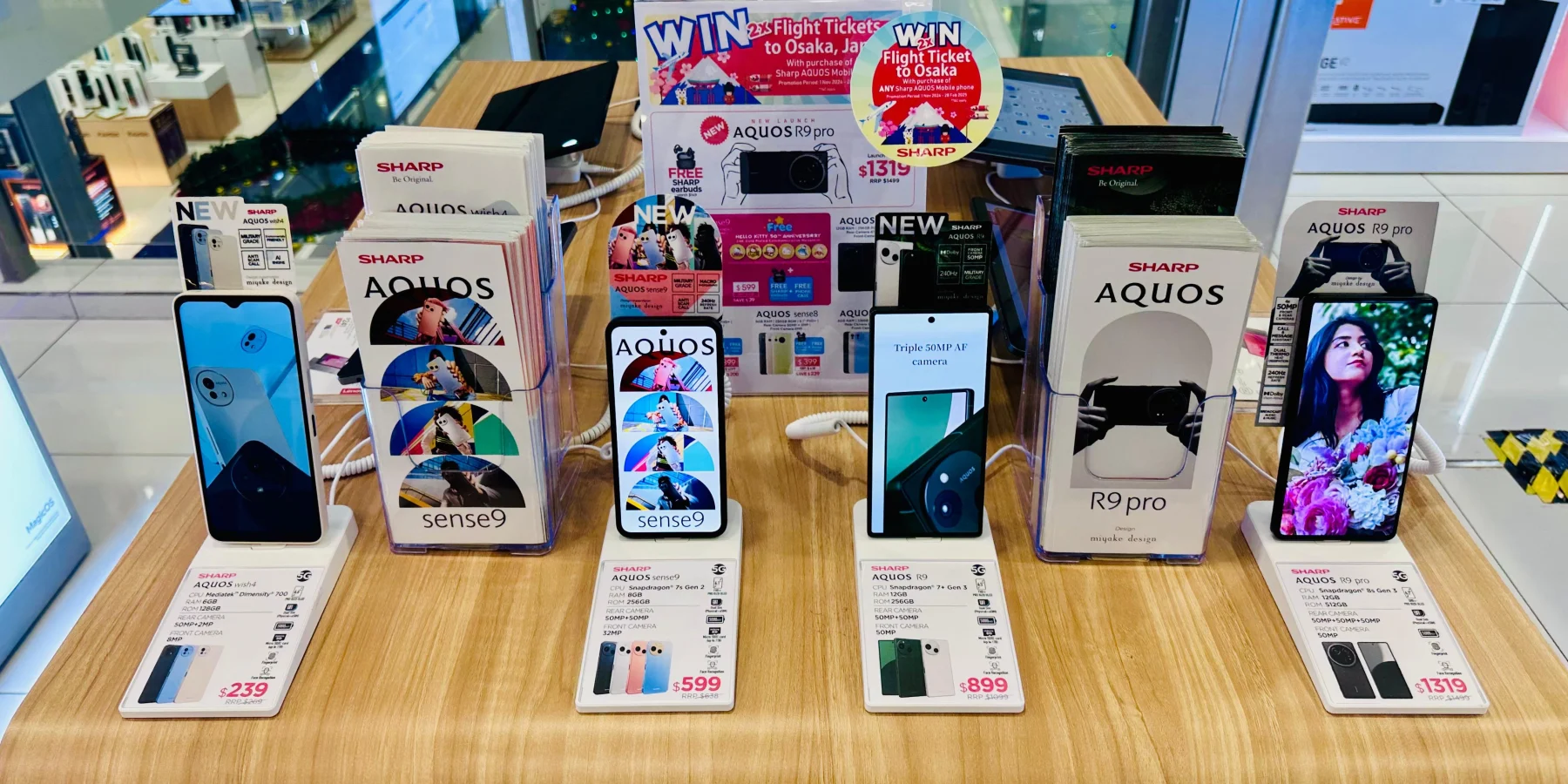
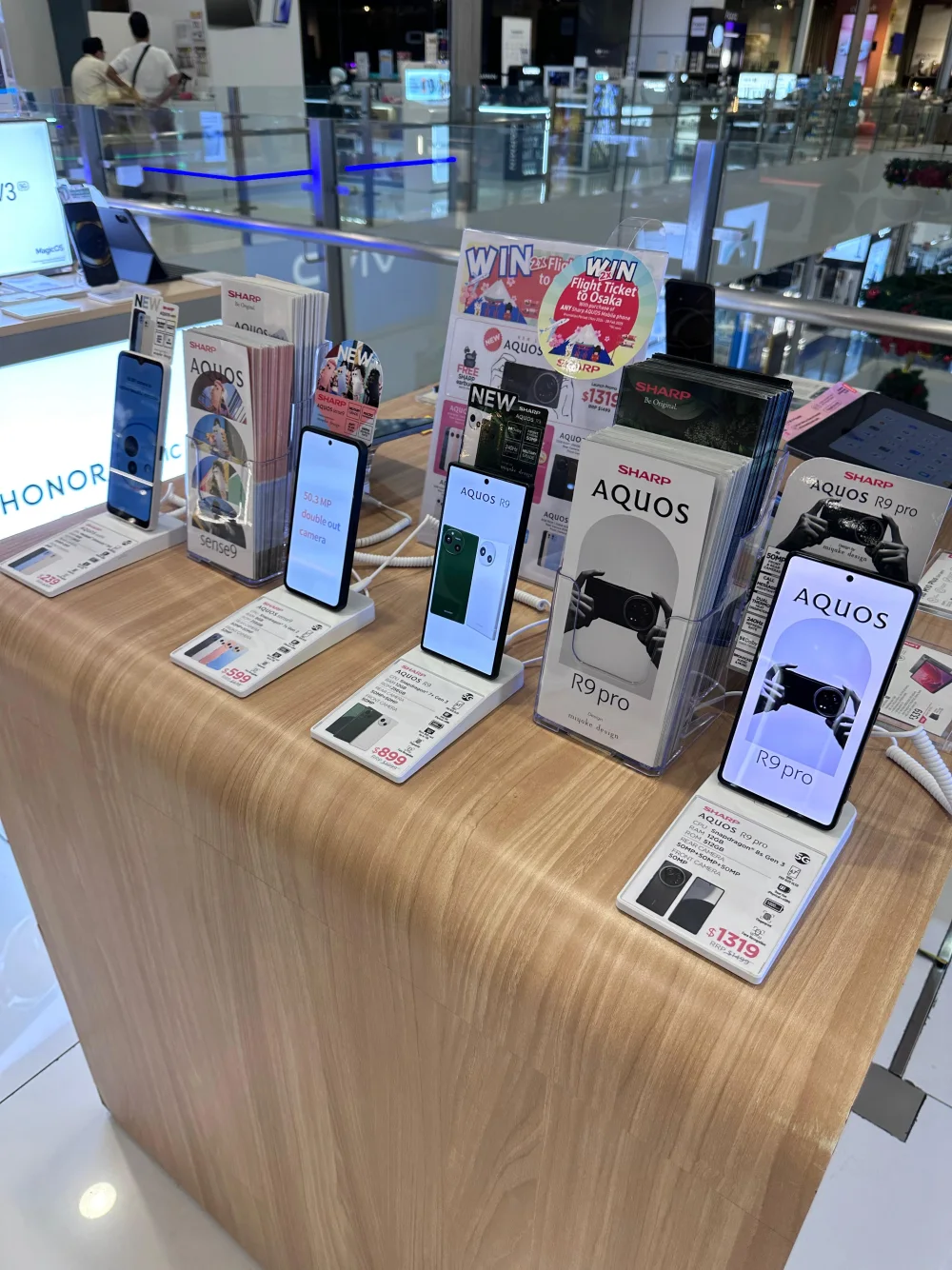
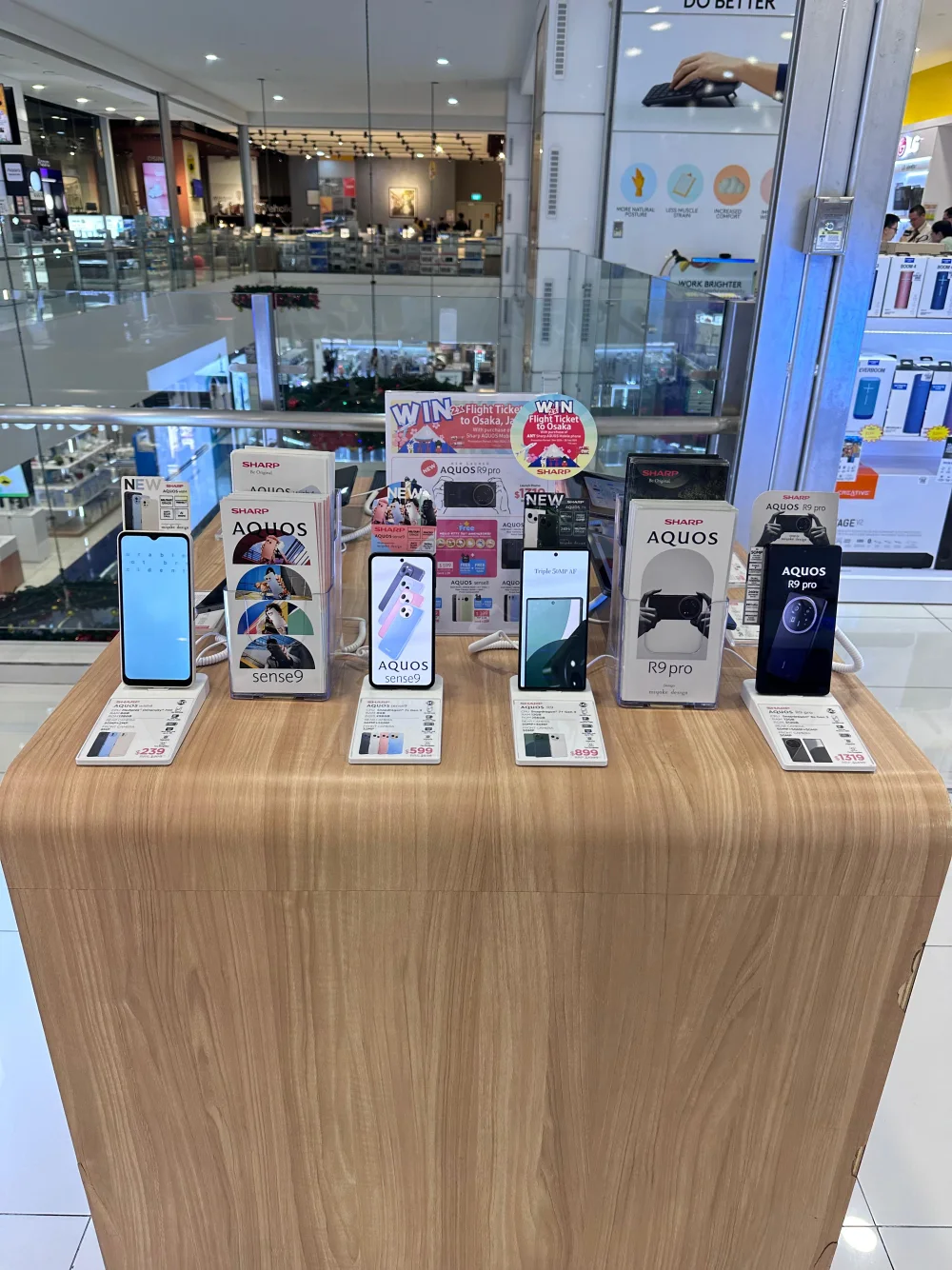
The photographs directly show PA-07-style integrated price cards, live phones, coiled security leads and repeated counter layouts in a Singapore retail setting. The operational analysis below explains the design implications; it does not claim measured sales uplift, shrink reduction or labor savings because no verified performance data was supplied.
The real display problem was information fragmentation
A phone fixture can fail even when the alarm performs perfectly. The device may be secure but poorly explained. The price card may drift away from the correct model. A promotion may be taped over an old tag. A charging cable may cross the information panel. On a counter with several similar devices, these small inconsistencies compound.
The photos show a demanding merchandising environment: several AQUOS models, multiple memory and camera specifications, promotional pricing and surrounding campaign materials. The customer must connect each live device to the correct information quickly. The store team must maintain that connection through model changes and new campaigns.
PA-07 addresses the problem through physical proximity. The price and specification card is built into the same footprint that presents and protects the phone. The association is not created by staff positioning two separate objects near each other; it is created by the fixture architecture.
Why the integrated format works
1. The label sits inside the decision zone
Customers comparing phones tend to alternate between screen, device body and commercial information. The closer these elements are, the less effort is required to verify which price belongs to which phone. PA-07 places the printed card immediately in front of the device, where the eye naturally lands after handling it.
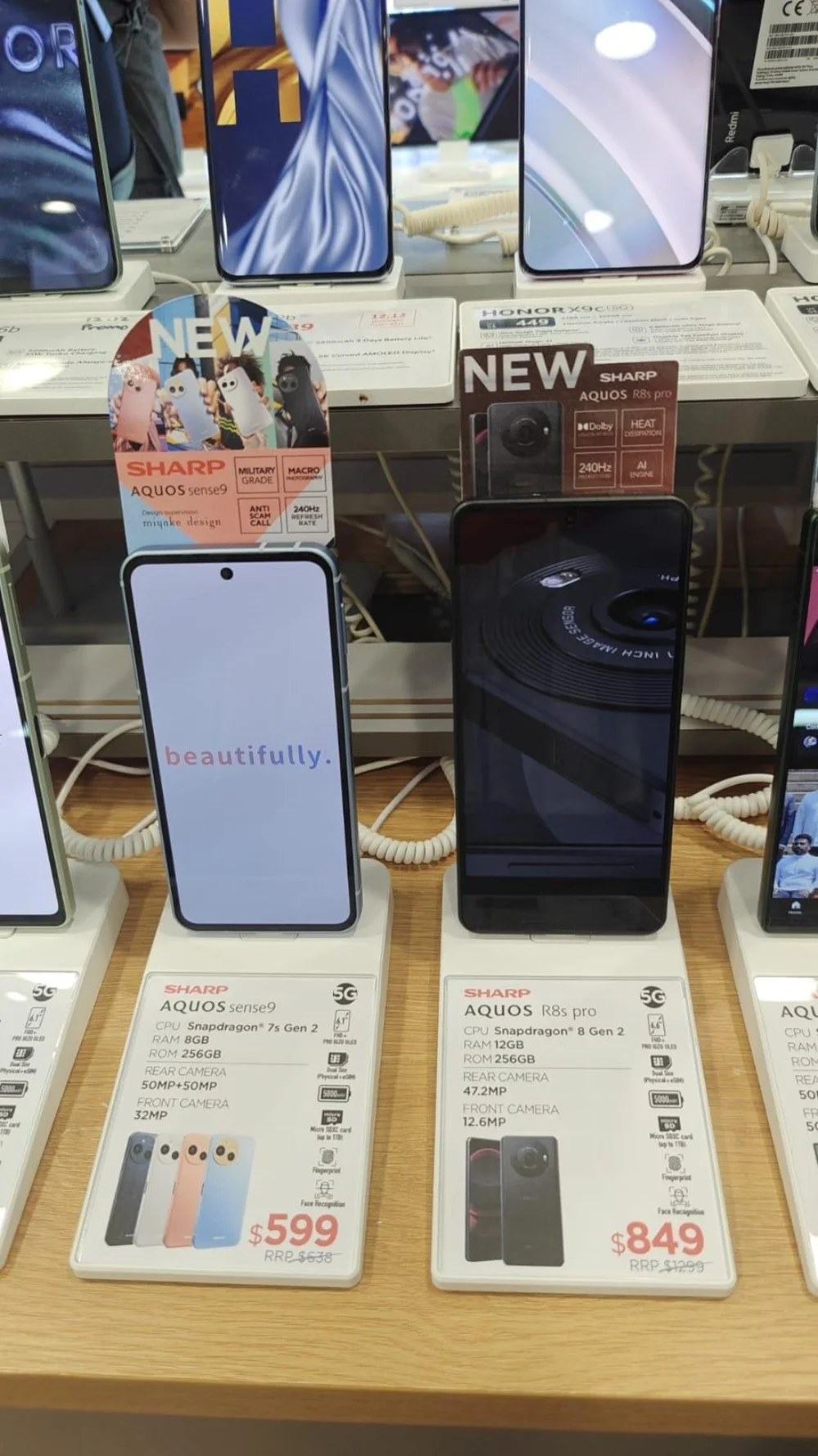
This is especially useful when products share similar industrial design. A shopper can distinguish a lower-priced entry model from a flagship by reading the card without searching for a shelf-edge label or asking staff to decode the display.
2. The printed card can carry more than a price
The Singapore cards use the available surface as a compact sales tool. Beyond a large price, they contain product images, memory and camera details, network information and variant cues. That turns the label into a structured comparison interface.
A good PA-07 card should follow a hierarchy: model name first, two or three decision-driving specifications second, price or promotion third, and secondary details last. The acrylic cover keeps that information flat, protected and consistently aligned.
3. Security remains compatible with hands-on retail
The deployment preserves the basic promise of live electronics retail: customers can touch and explore the phone. The coiled lead accommodates movement while the contact sensor and monitored cable provide local alarm triggers. The stand therefore supports interaction instead of replacing it with a locked cabinet.
4. Paper is a deliberate operational choice
PA-07 is not an electronic shelf label. In this use case, that is a feature rather than a limitation. A store can design the card in its existing artwork workflow, print locally and replace it without a gateway, battery cycle, radio network or software integration.
That makes the format particularly suitable when the number of display points is modest, the card includes rich promotional graphics, or campaigns change on a schedule that does not justify a full ESL system. Electronic labels remain valuable when prices change frequently across hundreds or thousands of SKUs; PA-07 solves a different problem at the live-device counter.
The strategic value of PA-07 is not “a security stand with extra space.” It is a single physical source of truth for the device, its commercial story and its protection.
What the deployment means for store operations
The fixture creates value only when the operating process around it is disciplined. The Singapore case points to a practical workflow that other retailers can adopt.
- Standardize the card template.
Lock the position of model name, hero specifications, price, previous price and product image. A stable template makes a mixed line-up easier to compare. - Assign one card to one display position.
Use an internal position or SKU identifier in the artwork file so staff can match the insert, phone and cable configuration before opening. - Update the card and device together.
When a phone or promotion changes, treat the stand as one merchandising unit. Replace the printed insert at the same time the device is installed. - Test alarm and charging during opening checks.
Verify device power, contact adhesion, cable connection and alarm release before customers enter. - Use the daily-removal connector correctly.
Disarm the stand before separating the phone for overnight secure storage; reconnect and test it the next day.
Three deeper lessons from the Singapore counter
Lesson 1: Fixture consistency can absorb campaign complexity
The environment contains substantial promotional material: model callouts, brochures, price offers and campaign graphics. Yet the repeated PA-07 footprint provides a consistent foreground rhythm. In other words, the fixture system can be quiet even when the campaign is visually loud.
This matters for multi-brand retailers. A universal display architecture can preserve counter order while each brand changes artwork, pricing and launches independently.
Lesson 2: Local control is often more valuable than maximum technology
Retail technology decisions are often framed as a race toward digitization. The better question is whether a technology reduces the work and risk of a specific process. For a limited set of high-consideration demo phones, a locally printed card can offer more layout freedom and lower operational dependency than a small-format electronic label.
The right comparison is therefore not “paper versus digital” in isolation. It is the total workflow: artwork creation, approval, price frequency, store count, network readiness, installation, troubleshooting and staff capability.
Lesson 3: Security hardware can carry merchandising value
Security equipment is usually treated as overhead. PA-07 changes the purchasing logic because the same footprint replaces or consolidates another fixture: the price holder. That does not automatically guarantee a lower total cost, but it changes what buyers should include in the comparison.
| Cost or task | Separate-fixture approach | PA-07 integrated approach |
|---|---|---|
| Hardware count | Security stand plus independent price holder | One primary display fixture |
| Counter alignment | Two objects must remain associated | Device and card share one footprint |
| Price update | Replace or reposition separate card | Lift acrylic cover and replace insert |
| Campaign design | Depends on holder format | Store-defined paper artwork within slot size |
| Technical dependency | Varies by price system | No software required for the paper card |
What we would improve in the next rollout
A useful case study should identify limitations as well as strengths. Based on the visible deployment, the next fixture plan could improve four areas:
- Reduce duplicate messages. When a price card, brochure and overhead campaign all repeat the same claim, the counter becomes harder to scan. Give each layer a distinct job.
- Control cable direction. Route coiled leads consistently behind or to one side of the phone so the information area remains unobstructed.
- Define minimum spacing. Leave enough room for customers to lift one device without catching the adjacent lead or card.
- Use a stronger card hierarchy. Keep the price and two primary specifications legible from normal standing distance; move dense detail to a QR code or brochure.
These are not product defects. They are reminders that fixture performance depends on the system around it: artwork, spacing, cable routing, staff routine and campaign governance.
A procurement checklist for similar projects
Before specifying PA-07 for a new store or chain rollout, confirm the following:
- Phone models, charging connectors and required output.
- Number of live display positions by store and counter.
- Available counter depth and preferred spacing between devices.
- Label content, language and final printable size of approximately 85 × 50 mm.
- Required decoder ratio: K07 for up to five stands or K06 for a single stand pairing.
- Opening, alarm-response and daily-removal procedures.
- Branding, color, packaging and spare-part requirements.
- Sample evaluation plan before volume rollout.
A sample should be tested with the actual device and a real printed card. Review the viewing angle, port position, sensor adhesion, customer reach, price readability and cable path on the intended counter material.
The case for a more useful display point
The Singapore project demonstrates a simple but important principle: retail fixtures perform better when their functions reinforce one another. The price card identifies and sells the phone. The charging connection keeps the demonstration alive. The alarm protects the same interaction. All three occupy one controlled footprint.
For stores that need rich printed product information but do not need a full electronic label infrastructure, PA-07 offers a practical middle path. It is not the most technologically complex answer. It is a focused answer to the actual work happening at the phone counter.
Planning a PA-07 counter?
Send Tocvue your device list, store photos, quantity and proposed label artwork. We can help confirm the model, connector, decoder and counter layout before sampling.
Request a PA-07 recommendation